EARTHQUAKE PRECURSORS:
WHAT ARE THEY AND HOW USEFUL ARE THEY IN EARTHQUAKE PREDICTION?
by Amelia Shire
Brunel University, Uxbridge
Introduction
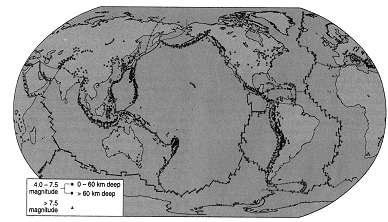
Earthquakes are caused by the sudden movement of blocks of the Earth's crust called 'plates'. This movement occurs along faults - which are the fractures in the rock, where built up strss suddenly release. There are different types of faults. More information on earthquakes can be found on this link to one of the USGS web pages. Figure 1 shows the Earth's earthquake prone areas. It can be seen that earthquakes tend to folow the lines of plate margins. The earthquakes shown on this figure were magniture 4.0 or greater and occurred between 1960 and 1989.
Figure 1 - (Murck, Skinner, Porter, 1997)
The elastically stored energy released by an earthquake is transmitted to other parts of the Earth in waves which spread outward from the earthquakes point of origin. These waves are called Seismic waves. They violently shake the ground and can cause absolute distruction to settlements in their path. Many buildings collapse (particularly if they were built with out following building codes), supplies can be cut off (for example: roads, gas, water), human life can be and often is lost in the rubble that is left. For this reason (the risk to human life), scientists from all over the world are trying to find ways to predict or forecast earthquakes.
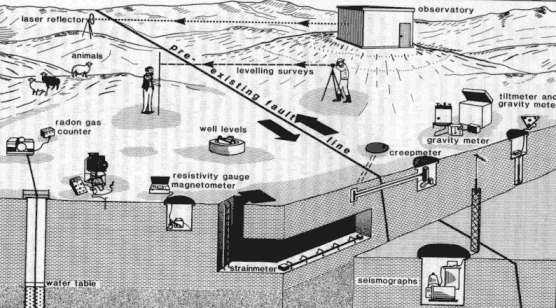
Earthquake prediction is 'a statement of probability based on scientific observation. Accurate prediction requires the continuous monitoring of geologic processes. Monitoring usually focuses on identifying anomalies that might be precursors' (Murck, Skinner, Porter, 1997). Scientists try to predict earthquakes by studying historical earthquakes, recent earthquakes, their fault systems, the geology of the area, mapping features that might change just before an earthquake, measuring levels of gas in ground water, and so on. 'Anomalous changes in the local environment often precede earthquakes. Some of these precursory phenomena can be detected only by means of scientific instruments, while others can be observed with the unaided human senses' (Soter, 1998). Figure 2 illustrates the potential range of monitoring methods which may be used for earthquake prediction along on active fault line. Only a selection of the methods shown would be employed at any one site.
Figure 2 - (Smith, 1996)
There are two broad types of earthquake precursors:
Microscopic anomalies - detected by only means of scientifis instruments
Macroscopic anomalies - observed with the unaided human senses
'They both span a wide range of phenomena and time-scales. The microscopic anomalies include changes in the frequency of weak foreshocks, emission of radon and other gases, and disturbances in magnetic fields. The macroscopic anomalies include unusual sounds just before the shock, diffuse glows and fireballs in the air, flames form the ground, electrostatic charging of the air, localised temperature increases, seismic gaps, unusual ground fogs, sulfurous smells, bubbling in bodies of water, human malaise, and bizarre animal behaviour' (Soter, 1998). I am only going to concentrate on a few anomalies, which are most useful for short term predictions, they are:
- Ground Deformation & Ground Water Fluctuations
- Animal Behaviour
Ground Deformation & Ground Water Fluctuations
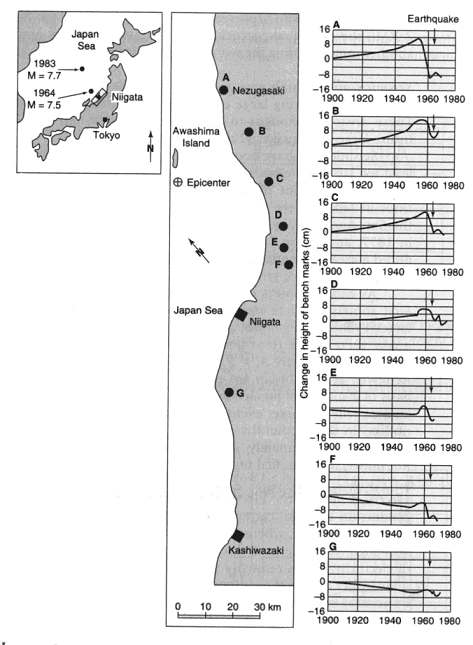
'Rates of uplift and subsidence, especially when rapid or anomalous, may be significant in predicting earthquakes'(Keller, 1997). Crustal rocks deform under the influence of tectonic strain, local cracking can occur causing the volume of rock to increase or dilate. If the cracking occurs quickly, groundwater may not immediately flow into the fissures. 'These spaces then become filled with water vapour with a reduction in the pore pressures within the rock' (Smith, 1996). Uplift due to tectonic movement was found to be a precursor before the Sea of Japan earthquake in 1983. The mechanism responsible for the uplift is thought to be deep, stable fault slip prior to the earthquake. This uplift is shown in Figure 3 below. The Anomalous uplift that occurred during the years before the magnatude 7.5 earthquake that struck Niigata, Japan. Uplift was measured by plotting changes in the bench marks (points of elevation) with time. The black dots are the locations of bench marks, and the graphs show the uplift at those locations. The data suggested that there was both uplift and subsidence for several decades until the mid 1950's, when an episode of rapid uplift occurred at all stations. This activity stabalised by about 1960 and was followed by several years of subsidence prior to the 1964 earthquake.
Figure 3 - Keller & Pinter, 1996)
Animal Behaviour
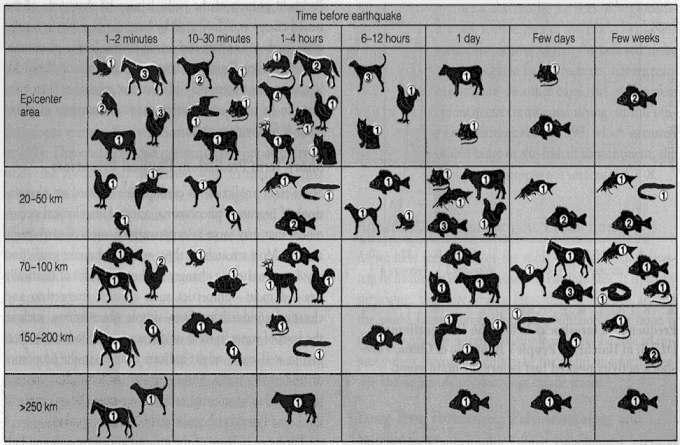
It has been observed that animal behaviours change before an earthquake and it has reported that once animal behaviour did actually foretell a quake. In 1969 in Tianjin, zookeeper reported to the earthquake prediction office, that they had seen unusual behaviour from some of the animals. A few hours later a magnitude 7.4 earthquake struck the region. 'Throughout the world there have been many reports, both documented and informal, of strange animal behaviour before earthquakes' Murck, Skinner, Porter, 1997). Japanese researchers have conducted extensive laboratory experiments to investigate the connections between animal behaviour and earthquakes. 'However, the Tianjin earthquake remains the only well-documented case in which the behaviour led to a successful prediction. Figure 4 below shows the spatial and temporal distribution of reported incidents of anomalous animal behaviour before the main shocks of 36 major earthquakes in Europe, Asia, North America, and South America. The symbols indicate unusual behaviour by catfish, eels, other fish, frogs, snakes, turtles, sea birds, chickens, other birds, dogs, cats, deer, horses, cows, rats and mice; the circled numbers indicate the number of reported incidents.
Figure 4 - Murck, Skinner, Porter 1997)
Conclusions
Despite such close servallance of earthquakes and their precursors, it is still impossible to predict earthquakes accurately. The main problem is that many earthquakes happen without reliable and observable precursor signals. 'One of the problems facing researchers is the problem in understanding the linkage between perceived precursor events, fault movement and the earthquake itself and therefore their significance in making predictions and issuing warnings' (Bennett and Doyal, 1997).
References
Bennett M.R. & Doyle P. (1997). Environmental Geology - Geology and the Human Environment First Edition. John Wiley & Sons, Chichester, England.
Keller E.A. & Pinter N. (1996). Active Tectonics - Earthquakes, Uplift, and Landscape. First Edition. Prentice-Hall International (UK) Limited, London.
Murck B.W. & Skinner B.J. & Porter S.C. (1997). Dangerous Earth - An Introduction to Geologic Hazards First Edition. John Wiley & Sons, New York.
Smith K. (1996). Environmental Hazards - Assessing Risk & Reducing Disaster. First Edition. Routledge Press, London.
Soter S. (1998). The Aigion Earthquake of 1995: Macroscopic AnomaliesFirst Edition.
http://www.brunel.ac.uk
http://www.quake.wr.usgs.gov
http://www.wallpaper.com
http://www.tinynet.com/faults.html
Bölgenizin yer durumunu her gün takip edin
Konumunuza göre günlük ölçüm raporu, yakınınızda 4 ve üzeri deprem
olduğunda anında bildirim ve bölgenizin bugünkü değerleri.
Premium üyeliği incele →